
Beyond sweet, sour, salty, and bitter lies a fifth, fundamental taste that transforms ordinary dishes into crave-worthy favorites: umami. Yet many home cooks sense something missing in their meals without realizing it’s this powerful savory element. In this guide to umami flavor explained exactly as it is given, we break down the science behind why it works, which ingredients naturally contain it, and how to layer it effectively in everyday cooking. Drawing on culinary research and professional kitchen techniques, you’ll learn how to recognize umami and use it to elevate simple recipes into deeply satisfying, unforgettable meals.
What Is Umami? The Science Behind the Sensation
Umami is often called the “fifth taste,” alongside sweet, sour, salty, and bitter. Scientifically, it’s the taste of glutamates—amino acids naturally found in foods like tomatoes, aged cheese, mushrooms, and seaweed. In plain terms, umami flavor explained means that deep, savory richness you notice in Parmesan or slow-cooked broth (the kind that makes you pause mid-bite).
Discovered in 1908 by Dr. Kikunae Ikeda, who isolated glutamate from kombu seaweed, umami isn’t a trend—it’s biology. Your tongue has specific receptors (T1R1 and T1R3) designed to detect it, signaling the presence of protein, an essential nutrient (Chaudhari et al., 2000).
Some argue umami is just saltiness in disguise. Not quite. Salt tastes sharp and mineral-like. Umami tastes rounded and brothy. They often team up—think soy sauce—but one doesn’t replace the other.
How to Use Umami in Your Kitchen:
- Add grated Parmesan to pasta for instant depth.
- Stir a spoonful of miso into soups or sauces.
- Roast mushrooms to concentrate natural glutamates.
Pro tip: Combine ingredients high in glutamate (tomatoes) with those rich in nucleotides (mushrooms) to amplify savoriness (Yamaguchi & Ninomiya, 2000). It’s flavor chemistry—no lab coat required.
Your Pantry’s Umami Powerhouses: A Chef’s Checklist
Before we dive in, a quick refresher on umami (the savory “fifth taste” linked to the presence of glutamates, first identified by Japanese chemist Kikunae Ikeda in 1908). Studies published in the Journal of Nutrition show that glutamates enhance palatability and can even increase satisfaction with lower-sodium dishes (NIH, 2019). That’s not chef folklore—that’s chemistry.
Here’s your evidence-backed, flavor-boosting checklist.
-
Fermented & Aged Products: Aging breaks proteins into free glutamates, intensifying savoriness.
-
Soy Sauce & Tamari – Fermentation unlocks deep, salty complexity (why a splash transforms bland stir-fry).
-
Miso Paste – Long fermentation equals higher glutamate levels.
-
Aged Cheeses (Parmigiano-Reggiano, Pecorino) – Parmigiano-Reggiano contains up to 1.2% free glutamate by weight (Consorzio del Formaggio Parmigiano-Reggiano).
-
Worcestershire Sauce – Anchovy-based fermentation adds layered depth.
-
Vegetables & Fungi: Naturally rich in glutamates, especially when ripe or dried.
-
Mushrooms (especially dried shiitake) – Drying concentrates guanylate, which synergizes with glutamate for a stronger savory punch.
-
Ripe Tomatoes (and tomato paste/sun-dried tomatoes) – Ripening increases glutamate content (University of California Agriculture).
-
Seaweed (Kombu, Nori) – Kombu is famously high in natural glutamates.
-
Sweet Corn
-
Green Peas
-
Meats & Seafood: Curing, drying, and cooking concentrate flavor compounds.
-
Cured Meats (Bacon, Prosciutto) – Slow curing amplifies savoriness.
-
Anchovies & Sardines – Tiny fish, massive impact (Caesar salad owes them everything).
-
Dried Seafood (Bonito Flakes, Dried Shrimp) – Essential in dashi, the backbone of Japanese cuisine.
If you’ve ever wondered about umami flavor explained in practical terms, this list is your proof: stock these, and your food tastes fuller—almost effortlessly.
The Synergy Effect: How to Multiply Flavor
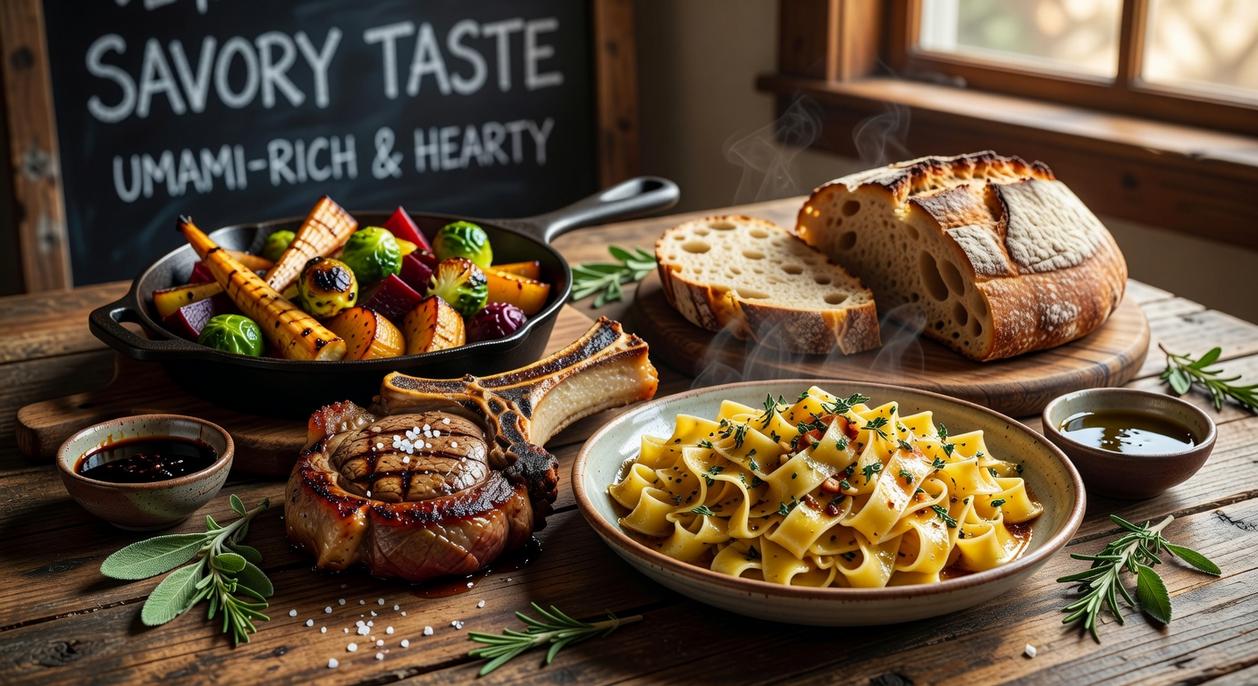
There’s a reason certain food pairings taste almost impossibly savory. It’s not magic. It’s chemistry.
Chefs call it the 1+1=8 rule. When foods rich in glutamates (natural compounds responsible for savoriness) combine with foods high in nucleotides like inosinate or guanylate, the result isn’t additive—it’s exponential. This interaction intensifies what scientists define as the umami flavor explained in sensory research as the fifth basic taste (Ikeda, 1908; Yamaguchi & Ninomiya, 2000).
Classic Synergistic Pairings
- Dashi broth: Kombu (glutamate) + bonito flakes (inosinate). The backbone of Japanese cuisine.
- Bacon cheeseburger: Cured beef (inosinate) + aged cheese and tomato (glutamate). Backyard cookout, meet food science.
- Chicken soup: Chicken (inosinate) + onions, carrots, and celery (glutamate). Comfort food with molecular credentials.
Some argue great cooking is about technique, not chemistry. Fair. A skilled cook can coax flavor from almost anything. But ignoring synergy is like ignoring harmony in music (sure, you can—but why would you?).
A Simple Kitchen Rule
Pair a protein (meat or fish) with a glutamate-rich vegetable or fermented ingredient. Think anchovies in tomato sauce or mushrooms with steak.
Looking ahead, expect more plant-based chefs to engineer bold combinations using seaweed, miso, and legumes—especially as interest in exploring mediterranean flavor profiles in classic recipes grows.
Flavor multiplication isn’t a trend. It’s the future of smarter cooking.
Practical Hacks for an Instant Flavor Boost
Ever taste a dish and think, it’s good… but something’s missing? That “something” is often umami flavor explained as the deep, savory taste that makes food feel complete. So how do you add it fast?
For Soups and Stews: Stir in a teaspoon of miso paste or a splash of soy sauce at the end. Why at the end? Heat can dull delicate fermented notes (and you want that punch, not a whisper).
For Sauces and Dressings: Add anchovy paste or a dash of Worcestershire sauce. Worried about fishiness? It melts away, leaving only savory depth. Ever had a Caesar dressing that tasted restaurant-level? That’s the trick.
For Roasted Vegetables: Grate aged Parmigiano-Reggiano over them straight from the oven. The residual heat melts it into salty, nutty magic.
The Secret Seasoning: Grind dried shiitake mushrooms into powder. Sprinkle on meats or stir into broths. Pro tip: store it in an airtight jar to keep its potency.
Bringing Richness and Depth to Every Meal
You came here for umami flavor explained, and now you understand how it transforms a dish from flat to deeply satisfying. No more serving meals that taste bland or one-dimensional. You know the secret: layering rich, savory elements that create balance and depth.
Don’t let another dinner fall short. Start by adding one or two umami-packed ingredients to your next recipe and taste the difference immediately.
If you’re ready to elevate every meal with confidence, explore more of our top-rated cooking guides and flavor breakdowns trusted by home cooks everywhere. Discover new techniques, try them tonight, and turn every bite into something unforgettable.