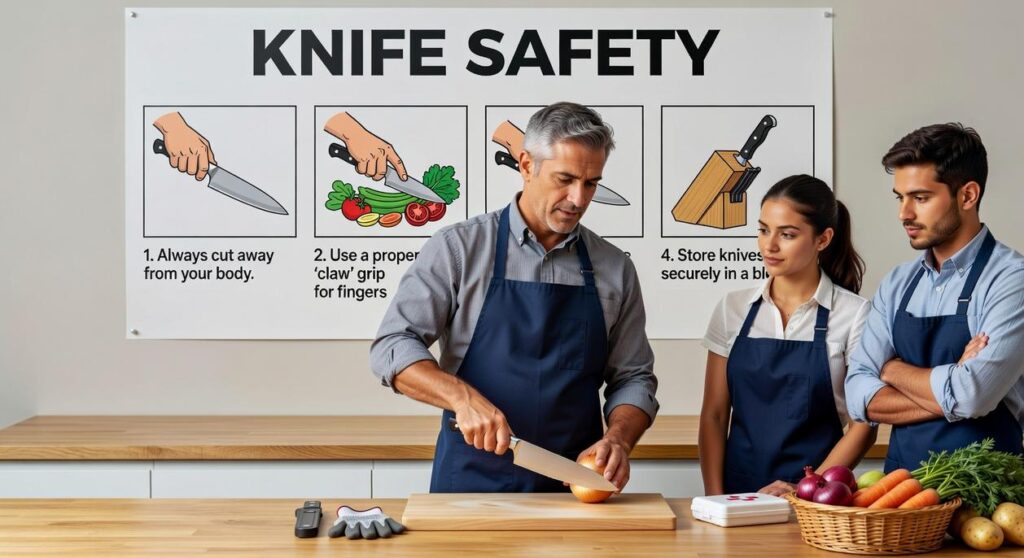
If you’ve ever felt intimidated by a sharp blade or frustrated by slow, uneven chopping, this guide is for you. In this article, you’ll discover how to master the most essential tool in your kitchen and finally feel in control of your prep work. We’ll eliminate the fear and inefficiency that come from improper handling and replace them with confidence, precision, and speed. These techniques are distilled from countless hours in professional kitchens and simplified into practical, step-by-step lessons. Whether you’re searching for knife skills for beginners or refining your foundation, you’ll learn the exact grips and cuts professionals use every single day.
Your Essential Toolkit: The Only Knives You Really Need
When I first stocked my kitchen, I bought the massive block—every blade gleaming, half never touched. BIG mistake. For true knife skills for beginners, you only need three.
The chef’s knife is the all-purpose workhorse, handling over 90% of tasks: dicing onions, mincing herbs, slicing meat, even smashing garlic. I once tried using a flimsy utility knife for everything. It slipped. Lesson learned.
The paring knife is for small, in-hand jobs—peeling apples, hulling strawberries, deveining shrimp. Think detail work, not power.
The serrated knife grips foods with hard exteriors and soft interiors, like crusty bread or ripe tomatoes. It saws cleanly where straight edges squish.
Why avoid the block? COST and clutter. Most sets duplicate functions. Three quality knives beat twelve mediocre ones (trust me every single day in practice). Pro tip: spend more on the chef’s knife; it earns it.
The Foundation of Safety and Control: How to Properly Hold Your Knife and Food

First, let’s address the grip most beginners use: the handle grip. This is where you wrap all five fingers around the knife handle like you’re holding a hammer. It feels natural (and a little dramatic), but visually, the blade tends to wobble because your hand sits too far back. Less control means less precision. In fact, culinary instructors consistently teach that control increases as your hand moves closer to the blade’s center of balance.
Enter the pinch grip—the professional standard. Here, you pinch the base of the blade between your thumb and index finger, while the remaining fingers wrap around the handle. By gripping the blade itself, you reduce lateral movement and improve accuracy. Research in motor control shows that precision improves when force is applied closer to the working edge of a tool (Schmidt & Lee, Motor Control and Learning). For knife skills for beginners, this adjustment alone can dramatically improve consistency.
Next, the claw grip—a non-negotiable safety rule. Curl your fingertips under so your knuckles face the blade. Your knuckles act as a physical guide, letting the knife glide safely along them. According to the National Safety Council, lacerations are among the most common kitchen injuries, often due to exposed fingertips.
Finally, create a flat, stable surface. Round vegetables roll (and rolling leads to slipping). Slice a thin piece off one side of a potato or onion before cutting further. Stability first—speed comes later. Pro tip: slow, controlled cuts are statistically safer than rushed ones.
Mastering the Four Fundamental Cuts
Great cooking starts before the pan even heats up. Master these four cuts and you’ll notice the difference immediately—cleaner presentation, even cooking, and better texture.
The Slice (The “Rocking Chop”)
The slice is the most common chef’s knife motion. The tip stays in contact with the cutting board while you rock the blade up and down, pushing forward through the food. Think of it as a smooth hinge motion rather than a straight up-and-down chop.
Best for herbs, mushrooms, and celery, this method is fast and controlled. Compared to a straight chop (which can crush delicate herbs), the rocking chop preserves structure and flavor. If you’ve ever watched a cooking show and seen that rhythmic motion—yes, that’s it.
The Dice (Creating Cubes)
Uniformity is the goal here. Even cubes cook evenly—no crunchy onions hiding in your sauce.
Using an onion:
- Step 1: Make planks. Slice vertically to create flat panels.
- Step 2: Cut planks into sticks. Keep spacing consistent.
- Step 3: Cut sticks into dice. Rotate and slice across.
Planks vs. random chunks? Planks win every time. Structure first, cubes second. It’s one of the core knife skills for beginners because it builds control.
The Julienne (Matchsticks)
Julienne creates long, thin strips—think carrot matchsticks or bell pepper slivers. First, square off the vegetable for stability. Then slice into thin planks, stack them, and cut into sticks.
Compared to a dice, julienne offers more surface area, which means faster cooking in stir-fries and better texture in salads and slaws.
The Mince (The Final Step)
Mincing means chopping something—like garlic or ginger—as fine as possible. Place your non-dominant palm on the spine near the tip, keep that tip anchored, and rock the handle rapidly.
Slice vs. mince? Slices give texture; mince melts into the dish. For faster meals after prep, explore one pan cooking methods that save time and cleanup and put these cuts to work immediately.
Last year, I learned this the hard way. I was slicing tomatoes with a dull chef’s knife, pressing harder and harder until it slipped and nicked my finger. That’s when it clicked: a sharp knife is a safe knife. Because a dull blade requires more pressure, it’s more likely to slide off food and cause injury.
So, first, always hand wash and dry your knives immediately. Dishwashers dull edges and loosen handles. Next, store them on a magnetic strip, in an in-drawer block, or with a blade guard. If you’re practicing knife skills for beginners, protecting the edge protects you.
From Novice to Nimble: Your Next Steps in the Kitchen
You came here to feel more confident with a knife in your hand—and now you have the foundation to do exactly that. What once felt intimidating no longer has to control your time in the kitchen.
That hesitation around sharp blades is replaced with control, precision, and purpose. By practicing the Pinch Grip and Claw Grip and repeating a few essential cuts, you’re building muscle memory that makes every slice smoother and safer. That’s why mastering knife skills for beginners works—it turns fear into fluid movement.
Now take action: grab an onion and practice your dice. Focus on technique, not perfection. One onion at a time, you’re building a lifelong culinary skill.