Struggling with dull blades that crush tomatoes instead of slicing them cleanly? This guide is designed to turn that frustration into confidence. Many home cooks feel unsure about where to begin, worry about damaging their knives, or end up with inconsistent edges that never seem truly sharp. Here, you’ll learn practical, proven knife sharpening techniques built around three essential pillars: angle, pressure, and consistency. We break the process into clear, actionable steps so you can start improving immediately. With focused practice and the right approach, you’ll transform knife sharpening from a chore into a reliable, repeatable skill.
The Foundation: Choosing Your Sharpening Stone
Choosing between WHETSTONES and electric sharpeners is like manual vs. automatic transmission. Both get you there—but the control is wildly different.
Whetstones offer:
- Precise angle control
- Sharper, longer-lasting edges
- Compatibility with most knife sharpening techniques
Electric sharpeners offer:
- Speed
- Convenience
- Less skill required
Some argue electric models are “good enough.” And for busy cooks, that’s fair. But they remove more metal and limit edge refinement (great for speed, not for craftsmanship).
Understanding Grit
- #400 grit: Repairs chips and reshapes dull edges
- #1000 grit: Primary sharpening workhorse
- #6000 grit: Polishing for razor refinement
Think of grit like sandpaper for steel—coarse fixes damage, fine perfects.
Best Beginner Pick
A dual-sided #1000/#6000 stone is versatile and cost-effective (pro tip: it handles 90% of home needs).
Proper Preparation
Soaking stones need 10–15 minutes in water. Splash-and-go stones just need a surface splash. Skipping this step? Your edge—and patience—will suffer.
Mastering the Angle: The Secret to a Consistent Edge
Angle is EVERYTHING. A consistent angle creates a clean, uniform bevel (that slanted surface that forms the cutting edge). Wobble even a few degrees and you don’t get “extra sharp”—you get rounded and dull. Think samurai sword, not butter knife.
Most guides stop at “hold 15–20 degrees.” But what they miss is why it matters biomechanically. Japanese knives typically thrive at 15–17°, while German or Western blades prefer around 20° for durability. That lower angle slices cleaner; the higher angle survives tougher tasks. According to Blade Magazine, thinner angles cut better but trade off edge retention under heavy use.
The “Stack of Coins” Trick
Place two coins under the spine for roughly 15°, three for closer to 20° (depending on blade width). It’s tactile. You feel the geometry. That sensory feedback builds muscle memory faster than guesswork (and yes, it’s oddly satisfying).
Using an Angle Guide
Clip-on guides help beginners, but the goal is freedom. Pro tip: use them for your first 5–10 sessions, then remove them every other stroke to test control.
Locking Your Wrists
Lock your wrist. Move from the shoulder and elbow. This stabilizes the stroke across the entire blade. Many knife sharpening techniques overlook this body alignment piece—but it’s the hidden edge.
Sharpen like you mean it. CONSISTENCY beats force every time.
The Sharpening Stroke: Perfecting Pressure and Motion
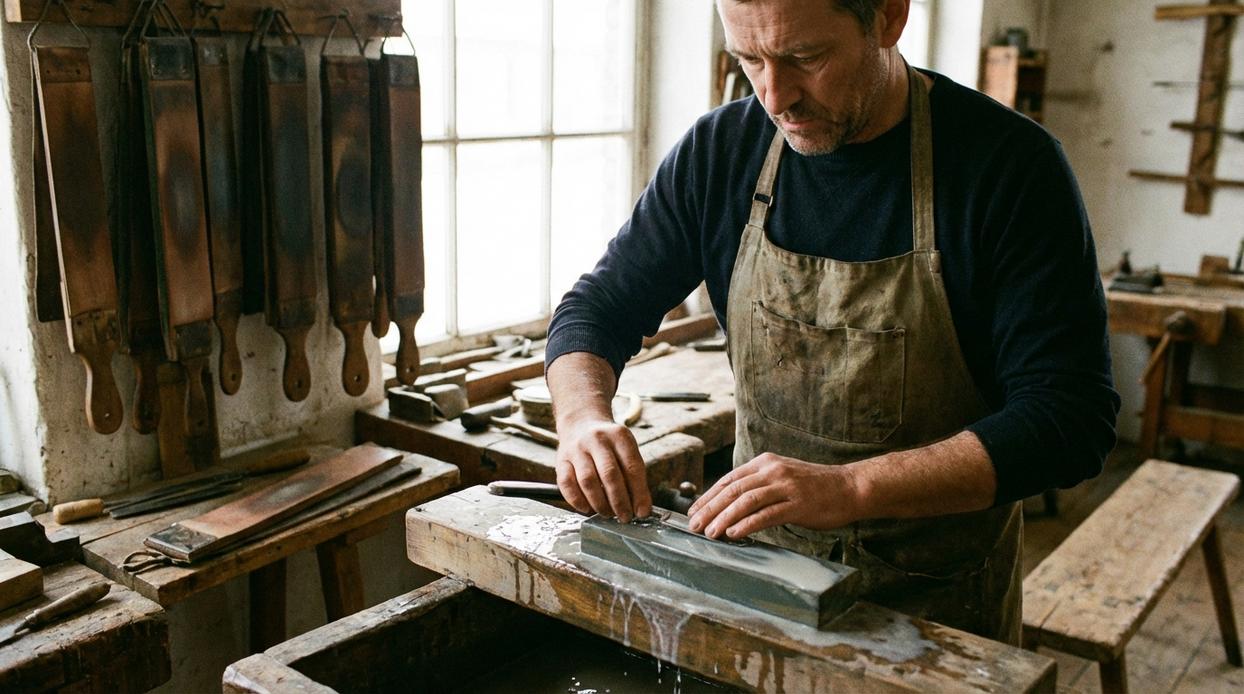
Mastering the sharpening stroke isn’t just about technique—it’s about control, consistency, and getting a blade that actually glides through food (instead of crushing it like a toddler with a crayon).
Edge-Leading Strokes mean pushing the knife across the stone as if you’re trying to slice a thin layer off the top. This motion keeps the edge aligned and reduces the risk of rolling it over. The benefit? A cleaner, sharper edge that performs better and lasts longer.
Applying Even Pressure is where most people slip up. Place your fingertips on the flat of the blade to distribute pressure evenly along the section you’re sharpening. Uneven force creates uneven sharpness. Even pressure gives you predictable, repeatable results—the foundation of all great knife sharpening techniques.
The “Burr” Is Your Goal. A burr is a tiny curl of metal that forms on the opposite side of the edge. Gently sweep your finger across (never along) the edge to feel for it. No burr? You’re not done. The burr is proof your effort is paying off.
Counting Strokes—try 10 per side—keeps both edges balanced. That symmetry means smoother slicing, faster prep, and less food waste (pair that with these smart food storage hacks to keep ingredients fresh longer for maximum efficiency).
Advanced Feedback: Using Sound and Touch to Refine Your Skill
Sharpening isn’t just visual—it’s sensory. First, listen to the blade. A dull edge makes a rough, scratchy sound on the stone. As it improves, the sound becomes smoother and more consistent. Eventually, a refined edge produces a high-pitched, hissing whisper (the kind that says, “I’m ready”).
Next, feel the ‘bite.’ A properly sharpening knife will seem to grip or bite into the stone, while a dull one skates across it like it’s late for a meeting. That resistance is feedback, not friction.
Now, the fingernail test—use with caution. Very gently rest the edge on your nail. A sharp blade will catch; a dull one slides. Proceed carefully; we’re testing sharpness, not bravery.
Finally, the paper test. A sharp knife should glide through paper cleanly, no tearing, minimal pressure. If it snags, revisit your knife sharpening techniques and try again.
Honing vs. Sharpening: Daily Care for a Lasting Edge
Clearing up the confusion, sharpening removes metal to create a new edge, while honing gently nudges the microscopic teeth back into line. Picture the faint rasp of steel on steel and the cool, smooth rod under your fingers. Therefore, hone frequently, even before each use, to keep that silky, paper-thin bite. However, when the blade slides over a tomato’s skin, it’s time to sharpen. Use proper motion: sweep the knife down a honing steel at a steady 15-20 degree angle, alternating sides. Mastering knife sharpening techniques preserves that bright, clean slice.
Your Next Steps to Sharpening Mastery
You set out to understand the fundamentals behind truly effective knife sharpening techniques—and now you have them. With the right angle, controlled pressure, and consistent feedback, you’re no longer guessing. The dull, frustrating drag of a lifeless blade can be replaced with clean, effortless cuts and total control in your kitchen.
The difference is practice. A methodical approach builds muscle memory and sharpens your awareness as much as your blade.
Start with one inexpensive knife. Set aside 15 focused minutes today. Listen to the edge, feel the resistance, and refine your stroke. Commit to mastering the process—and enjoy the precision you’ve been missing.